
Recommended:
Trending Side Hustles Online
I’ve been burned before, so let me help you avoid the same.
Years ago, I was throwing money at solo ads like most people do — $40 here, $60 there — watching clicks trickle in and hoping something would stick. Some days I’d get a handful of subscribers. Most days I’d get a lighter wallet and a heavier sense of frustration. It took me a while to see what was really happening: I was renting attention instead of building something I owned.
That shift in thinking changed everything for me, and I want to walk you through it because I wish someone had laid this out for me years ago.
Why Buying Leads Is Better Than Most Solo Ads for Long-Term Value
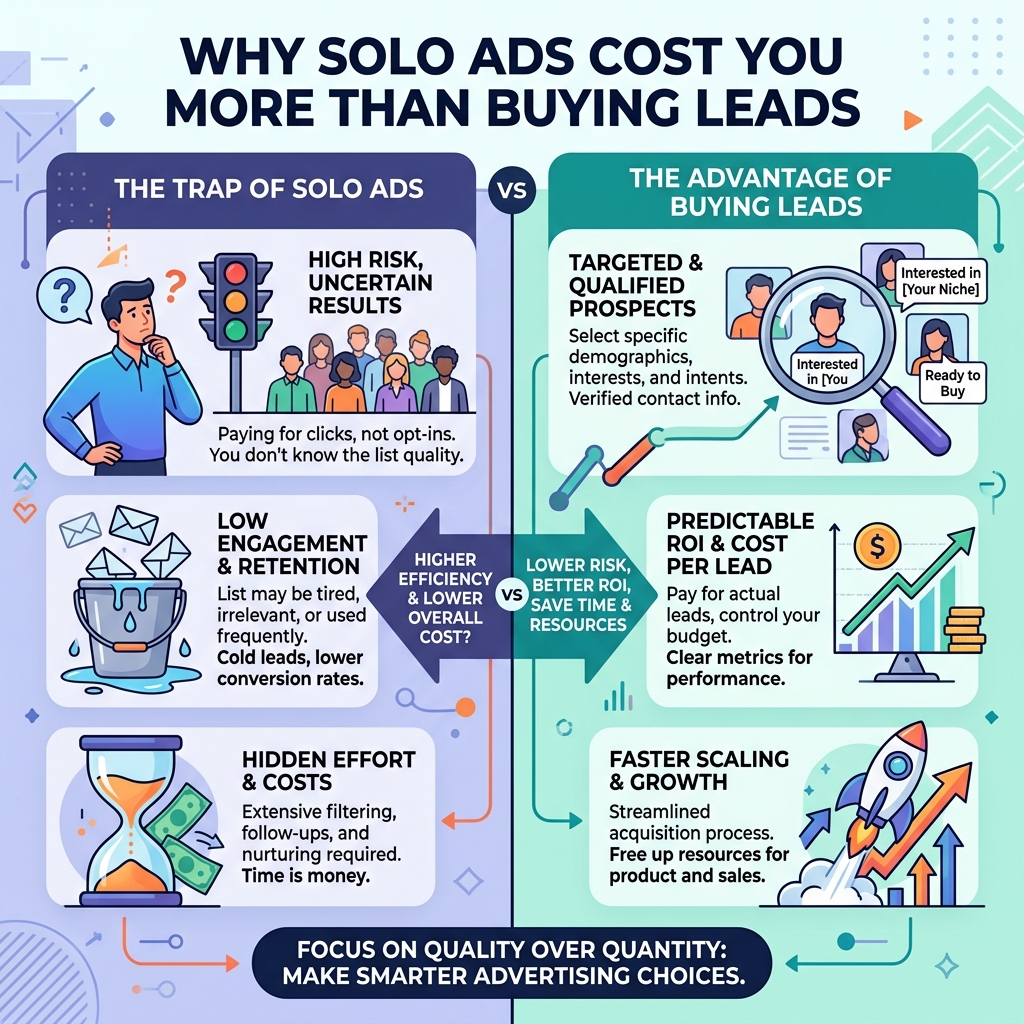
Here’s how the solo ad cycle usually goes. You pay around $0.40 per click on average. Maybe 100 clicks land on your opt-in page. On a good day, 30% convert. That’s 30 subscribers for $40 — about $1.33 per subscriber.
Then it’s over. The traffic stops. You go find another seller and do the whole thing again next week. This cycle burns through cash fast, and you’ve got nothing to show for it between rounds.
Now compare that to buying leads directly. You’re paying $0.50 to $1.00 per contact depending on the source — and you skip the conversion step entirely. No landing page gamble. No waiting to see how many clicks actually turn into subscribers. You add them to your list immediately and start sending emails the same day.
The math isn’t complicated. It just favors the person who owns the contacts.
When You Need Speed, Solo Ads Slow You Down
This is something nobody talks about.
Solo ads require coordination. You write your swipe copy. You wait for approval. The seller schedules your spot in their queue. Sometimes this takes three days. Sometimes a full week. Your campaign sits idle while you wait.
Purchased leads? You download the file, import it into your autoresponder, and trigger your first email sequence — all before lunch.
When you’re testing offers and need data fast, that speed matters enormously. Solo ads drip in results over 24 hours. Purchased leads let you send multiple follow-up messages within hours. You see patterns in your stats by evening instead of guessing for days.
The Quality Argument People Get Wrong
I hear this one all the time: “Solo ad traffic is higher quality because people clicked willingly.”
It sounds logical. But it misses the bigger picture.
Solo ad traffic came from someone else’s list. That list was built by collecting emails over time — and many of those emails started as purchased leads from other sources. The circle completes itself. You’re often paying a premium for the same type of person you could’ve reached directly.
Here’s what actually determines quality: the source, not the method.
Bad solo ad sellers send bot clicks and fake opens. Bad lead sellers scrape outdated emails from expired lists. Good providers in both categories verify their contacts and filter out junk. Either way, you’re doing your homework on the vendor. The difference is that with leads, your homework costs you less per contact.
Testing Funnels Without Burning Your Budget
This is where I really started to see the advantage.
Solo ads force you to commit to one funnel before you see results. You send all 100 clicks to the same page. If that page doesn’t convert well, you wasted the entire budget. Start over tomorrow with another $40.
Purchased leads split into segments easily. Upload 500 contacts, divide them into five groups, and let each group see a different email angle or offer. Compare open rates and click rates across all five tests. The winner becomes your main campaign going forward.
You test subject lines on Monday. Offer positioning on Wednesday. Different products on Friday. Each test costs the same price per lead. Solo ads charge you full price for every single test. That flexibility compounds over weeks in a way that solo ads simply can’t match.
Building an Asset vs. Renting Attention
This is the part I care about most, because it’s the difference between building a real business and running on a hamster wheel.
Solo ads rent attention for a moment. Traffic flows through your funnel once. People who don’t buy disappear forever. You own nothing except the few who joined your list. The rest vanish.
Buying leads builds a permanent asset. Every contact joins your database. You email them for months or years. Some people buy after the seventh email instead of the first — and you still profit from that relationship because the lead is yours.
A list of 5,000 engaged contacts produces income every week. You promote a new offer and generate sales without paying for new traffic. You used the asset you already built.
Eventually, your list becomes a business itself. Other marketers pay you to send solo ads to your contacts. You become the seller instead of the buyer. That flip only happens when you own the leads.
The Hidden Costs Nobody Mentions
Solo ads seem simple until you add up the real stack:
- Solo ad seller: $40 per batch of clicks
- Landing page software: ~$27/month
- Email autoresponder: ~$19/month
- Split testing tools: ~$49/month
That’s $95/month in overhead before you buy a single click.
Purchased leads need only an autoresponder. You skip the landing page because the leads already converted somewhere else. You skip the traffic cost because you bought direct access. Your overhead drops significantly.
And then there’s your time. Solo ads require constant outreach to new sellers. Vetting each one to avoid scams. Negotiating prices and schedules. Monitoring delivery quality. That takes hours every week. Purchased leads arrive on demand from the same reliable sources. Commit to it and give it all you got — but give it to the thing that actually scales.
Scaling Without the Nightmare
Good solo ad sellers only have so much inventory. Maybe 500 clicks per week, maximum. You need 2,000 clicks to meet your growth targets? Now you’re searching for three more sellers at the same quality level. It becomes a logistics nightmare, and more sellers mean more variability in quality. One bad batch tanks your conversion rate.
Lead providers handle bulk orders easily. Order 5,000 contacts Monday, get them Tuesday. Order 10,000 more Wednesday. They scale with your budget. One relationship covers your entire growth plan, and your results stay predictable as you grow.
Where Solo Ads Still Make Sense
I want to be honest here — I’m not saying solo ads are useless. They’re not.
Solo ads work well in narrow niches where bulk leads don’t exist. A solo ad to 100 cryptocurrency investors might outperform 1,000 random business opportunity leads. They also help when you need to test message-market fit quickly. Spend $40 to validate demand before committing to bigger lead purchases.
And some sellers — the rare ones you usually find through referrals — provide genuinely engaged audiences they’ve built over years. Those lists convert at 40% to 50%. You pay a premium, but the results justify it.
Most solo ads don’t fit these categories, though. They promise results they can’t deliver. They recycle the same tired traffic across dozens of buyers. You pay top dollar for bottom-tier results. I’ve been burned before, and I’ve watched too many good people get burned the same way.
How to Avoid Garbage Leads
I’d be doing you a disservice if I didn’t talk about this. Bad leads waste money faster than bad solo ads.
You import 1,000 contacts and see a 2% open rate instead of the expected 15–25%. Nobody clicks. Nobody buys. You just burned your budget on dead emails. This happens when providers source from outdated databases or unverified contact information instead of fresh opt-ins.
Here’s how to protect yourself:
- Test small first. Order 100 contacts before committing to 1,000. Send an email within 24 hours.
- Check your numbers. Open rates above 15% signal decent quality. Bounce rates below 5% confirm the emails are real.
- Ask about the source. Leads from survey completions and content downloads perform better than scraped emails. People who entered their information willingly respond to follow-up.
- Watch for red flags. Real buyer data costs $3 to $5 per contact minimum. Anyone selling “buyer leads” for $0.75 each is lying. You’ll receive the same opportunity seeker leads everyone else gets.
Put members first — starting with yourself. Protect your investment before you scale it.
What to Send When You Start
Your first email determines everything. Purchased leads don’t remember opting in to your specific list. They joined something else weeks ago. Your message needs context or they’ll delete immediately.
Start with a reminder. Something like: “You requested information about making money online recently.” This jogs their memory. They recognize the topic even if they don’t remember the exact form.
Deliver value first. Share a quick tip or useful resource before pitching anything. Build a moment of goodwill. The second email can introduce your offer. That first email establishes that you’re helpful — not just another spammer.
Send your sequence quickly. Email on day one, day two, and day three. People who just submitted their information are most engaged right now. Waiting a week means they forget completely.
I learned this the hard way, too. My early emails were all pitch, no warmth. The moment I started leading with something genuinely helpful — the way I’d talk to a friend — everything changed. Open rates went up. Replies started coming in. People actually wanted to hear from me.
Frequently Asked Questions
Do purchased leads convert as well as solo ad traffic? They convert at similar rates when sourced properly. Both methods attract opportunity seekers looking for solutions. The key difference is that leads cost less per contact overall.
How many emails should I send to purchased leads? At least five in the first week. People need multiple exposures to your offer before they buy. After the first week, two to three times weekly keeps you top of mind without burning the list.
Can I get banned for importing purchased leads? Most autoresponders allow purchased leads from legitimate sources. Read your provider’s terms of service first — some platforms require confirmed opt-in only.
What open rate should I expect from purchased leads? Between 15% and 25% on your first email. Rates drop to 10–15% after several messages. Anything consistently below 10% means poor lead quality.
Is buying leads legal under privacy laws? It’s legal in most countries if the contacts agreed to receive offers. Verify that your provider follows GDPR and CAN-SPAM compliance rules. Always include an unsubscribe link in every email.
The Bottom Line
I spent too long chasing shiny objects — jumping from one solo ad seller to the next, hoping this batch would be the one that finally worked. It took me a while to realize I was building on rented land every single time.
The moment I started owning my leads — building a list I controlled, sending messages on my schedule, testing on my terms — everything shifted. Not overnight. But steadily. Predictably. In a way I could actually trust.
If you’re stuck in that cycle right now, feeling like you’re spending more than you’re making and wondering if this whole online thing even works… I get it. I’ve been there.
By the way, if you want a system that actually puts all of this to work for you — the lead follow-up, the email sequences, even an AI that answers questions and closes sales for you 24/7 — check out the Turnkey Residual Income System. You can earn $128 in residual commissions per customer, and the done-for-you sales system handles the selling. Link’s in the description below.
Start building your asset today instead of renting traffic that disappears tomorrow.
Recommended:
Simple Ways To Make Money Online